

We’re not shy about our all-in-one approach to creating stellar brand experiences.
Full-service, end-to-end, one-stop-shop from ideation to fulfillment… It sounds great however you spin it but what exactly does it entail? Behind the curtain, there are loads of moving parts our clients don’t think about. And to be honest, they don’t have to think about them even if they wanted to because we have our operation dialed.
We squeezed our way into Carl’s calendar—the master behind our operational excellence—to chat logistics: How he’s navigated expansion in our U.S. headquarters and international fulfillment centers, how his crew maintains quality control across the globe and how, as a team, they’ve perfected the art of making the clock turn faster by transforming mundane tasks into something people actually look forward to doing.
Carl is our Senior Vice President of Operations, also known as the “finisher,” the guy who makes sure we deliver all of the big promises we make.
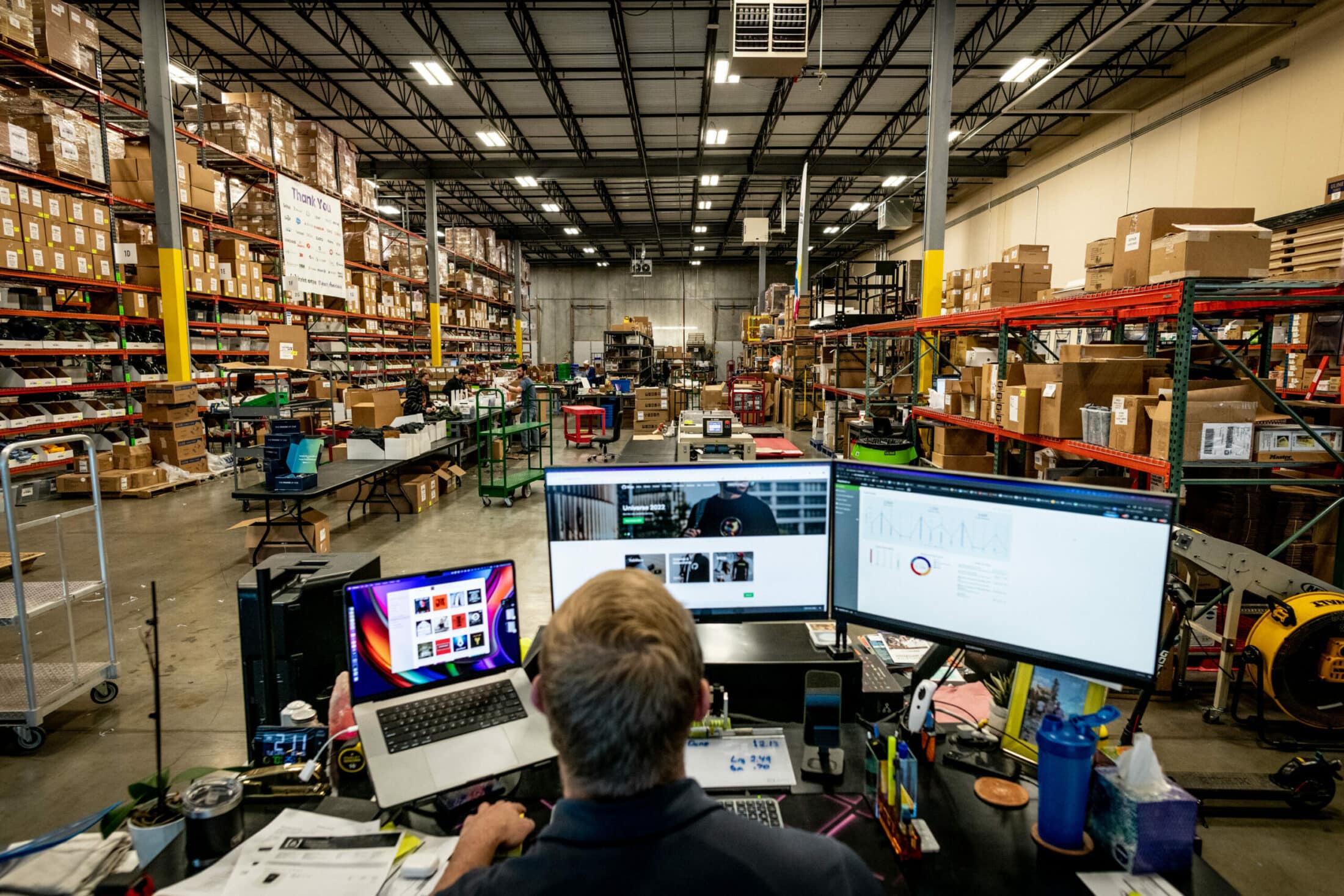
When Carl joined Imprint Engine, our assembly line consisted of three picnic tables, four shelves and one tiny scale—a far cry from our current 34,000 square foot warehouse. Long gone are the days of playing Tetris and memory games to locate inventory. Now, Operations is capable of running multiple large scale projects at once with many of their folks encouraged and empowered to lead projects and take total control of their own workdays.
But with such a massive space, more hands on deck and a grander scale operation, how does the Operations team guarantee consistency? Carl makes it sound pretty simple: Templates. Communication. And make every first time the perfect time.
Like any big play or relay, the handoff is key.
Most of us have experienced a workplace where “processes” never really work. They often result in too many tedious templates that never get used or they implode before the ball even gets rolling. In our operation, templates not only work, but they’re why we can seamlessly design, produce, assemble, pack and ship high-quality products to over 186 countries each year. Our warehouse is adjacent to the front office where the sales, leadership, marketing and design teams sit at their desks every day. Yet our communication with them is equally as streamlined as it is with remote employees, our team in Europe and our suppliers around the world thanks to, yes, you guessed it, process.
Obviously the consolidated workspace doesn’t hurt our communication skills, but quality control is where our in-house factor truly shines. Carl, and really anyone in our U.S. office, can walk right over to any designer’s desk, production station, or assembly line and see a project’s progress in real time. We’re not losing days shipping back and forth between third parties, so we’re ultimately maximizing cost and logistics efficiency when we distribute the final product.
And if something goes wrong? No biggie. Customer support is in-house, too, led by the very team that produced and shipped the goods.
Nobody wants to be on the phone with customer support in the first place, so we made sure that customers are calling the people who have the answers right away. And while we unfortunately can’t have a Carl in every one of our fulfillment centers around the world, our global partners are always aligned so that no matter what products we’re delivering, we’re delivering them consistently.
Maintaining a high level of craftsmanship across thousands of units per day sounds complicated, but it’s really not. Carl says it’s not rocket science, which is exactly why mistakes happen. It’s easy to get in (or out of) the zone in the assembly line, but we also know there is not enough time in the day to do things twice. So we stay focused by gamifying it! Even the most mundane tasks fly by when they become a friendly competition.
The goods arrive safely, neatly, with some surprise and delight and that’s where the fun can come in! It might seem silly, but the team has fun with it. “It’s a cool culture back there,” says Carl, “they hang out on the weekends… through that culture they challenge each other and turn it into a game with prizes.” He also brags that it’s not uncommon for his team to glance at the clock and think, ‘How is it 4:00 already??’ (Must be nice!)
Experiences that leave an impact and products that people actually want to use and keep are our bread and butter. And we wouldn’t be able to create either of those things without our exceptional Operations team.
Get in on our expertise and take 3 of Carl’s pro tips for Operational Excellence:
- Commit to a process that works. For a consistently seamless handoff, create templates that are easy to use.
- Remember that it’s a waste of time to do things twice. To maintain quality control, make every first time the perfect time.
- Build camaraderie and have fun with your team! When assembly lines get monotonous, incentivize by gamifying.